Indestructible Dog Crate
The-Hunting-Dog is supported by its audience. We may receive commissions on purchases made from links on our site.
A large, strong dog can put a lot of strain on a crate. If yours has cracked a plastic shell, bent the bars, or pushed a door out of line, look closely at where the old crate gave way. Bent metal and broken plastic can leave sharp edges that could injure you or your dog. Heavy-duty crates are a little more complicated to choose than ordinary ones. Think about how the door closes, whether the floor is comfortable, and how much room your dog will have inside. The comparison below gives you a place to start.

Grated floor; single front entrance. Warranty excludes dog damage.
One-inch floor gaps and two-inch bar spacing in seller specifications.
81.8 lb in current seller description; grated floor; no verified crash rating.
Manufacturer does not recommend this model for escape history, severe anxiety or destructive behavior.
Manufacturer/seller says collapsible models may not suit anxiety or destructive behavior.
Before choosing a stronger crate
A stronger dog crate can offer thicker framing, more substantial latches or a molded shell. It cannot guarantee that a dog will never escape, and it cannot make a panicking dog comfortable. Before shopping for an “indestructible” crate, work out whether the problem is failed hardware, an unsuitable fit or distress about confinement.
The seven options below include fixed steel crates, folding aluminum designs and molded kennels. They serve different dogs and different jobs. The folding models are specifically limited to dogs comfortable in confinement; none is presented as a treatment for separation anxiety.
If your dog is biting bars, forcing the door or hurting themselves, stop the trial and use a safe supervised arrangement while you contact your veterinarian. Our guide to handling crate escape attempts explains what to inspect and record before deciding whether new equipment can help.
A closer look at the seven crates
1. ProSelect Empire — Medium
ProSelect Empire — Medium
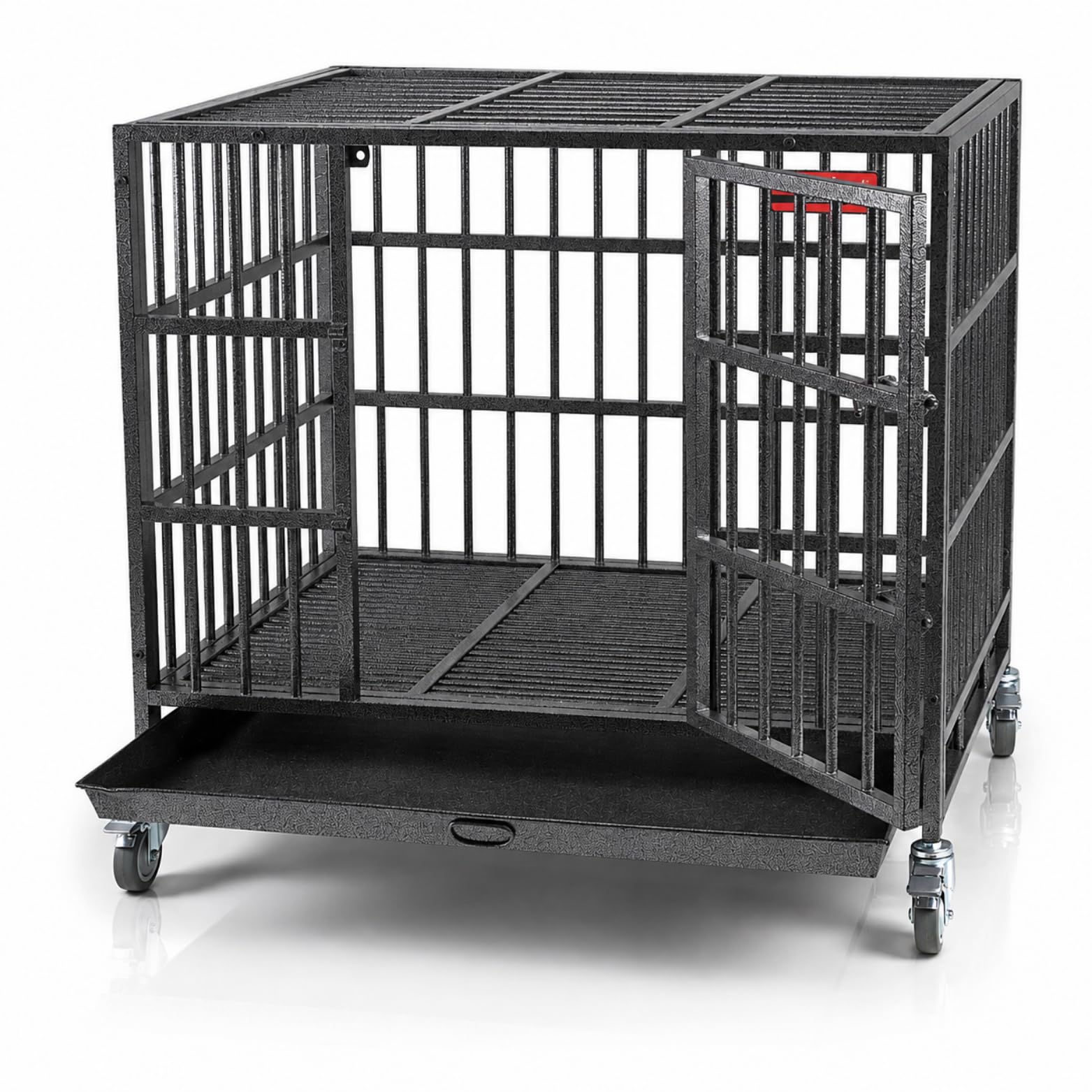
The ProSelect Empire is the straightforward steel option here: a fixed frame, a front door with two latches, a removable floor grate and a steel cleaning tray. Its 20-gauge frame is reinforced with half-inch steel tubing. The four locking casters can be removed, so rolling the empty crate for cleaning is optional.
The important measurement is the 24½-inch inside height, not the 33¾-inch overall height including the base. A dog that needs more headroom will not gain it from the taller external measurement. The usable interior is 35¾ × 23½ inches.
Choose it for its documented construction and access to the tray, rather than a promise that a dog cannot damage it. The manufacturer’s limited warranty excludes damage caused by the dog. The grated floor also deserves a careful paw and comfort assessment before routine use.
Fit reference: outside 37 × 25⅛ × 33¾ in. Inside: 35¾ × 23½ × 24½ in.
Pros
- Documented inner and outer dimensions make fit easier to assess.
- Removable locking casters and a slide-out steel tray.
- Two latches on the front door.
Cons
- The medium model has only 24½ inches of inside height.
- Grated floor; dog damage is excluded from the limited warranty.
2. LUCKUP — 42-inch

LUCKUP — 42-inch
This 42-inch LUCKUP has a coated steel frame, a slide-out plastic tray and four rotating casters. Its listed overall footprint is 41.5 × 30.5 inches, with a total height of about 37 inches. The seller separately specifies 32 inches of internal height, which is the more useful figure for headroom.
There are two locks with safety buckles. These give you specific hardware to inspect before closing the crate: the door should align, both locks should engage fully and the buckles should be secured. A lock count alone does not establish that the crate is suitable for a dog trying to bite or force the door.
The seller lists two-inch spacing between the metal bars and one-inch spacing in the slatted floor. That floor is a meaningful limitation for small paws and for dogs that cannot rest comfortably on a grate. The removable tray underneath is for cleaning; do not mistake it for a solid sleeping floor.
Fit reference: outside 41.5 × 30.5 × 37 in. Inside: 32 in internal height; full internal footprint not documented.
Pros
- Slide-out tray and rolling base simplify access for cleaning.
- Seller distinguishes internal height from total height.
- Safety buckles supplement the door locks.
Cons
- One-inch floor gaps need a careful paw and resting-surface assessment.
- A complete usable internal length and width were not verified.
3. LEMBERI — 48-inch, Black
LEMBERI — 48-inch, Black
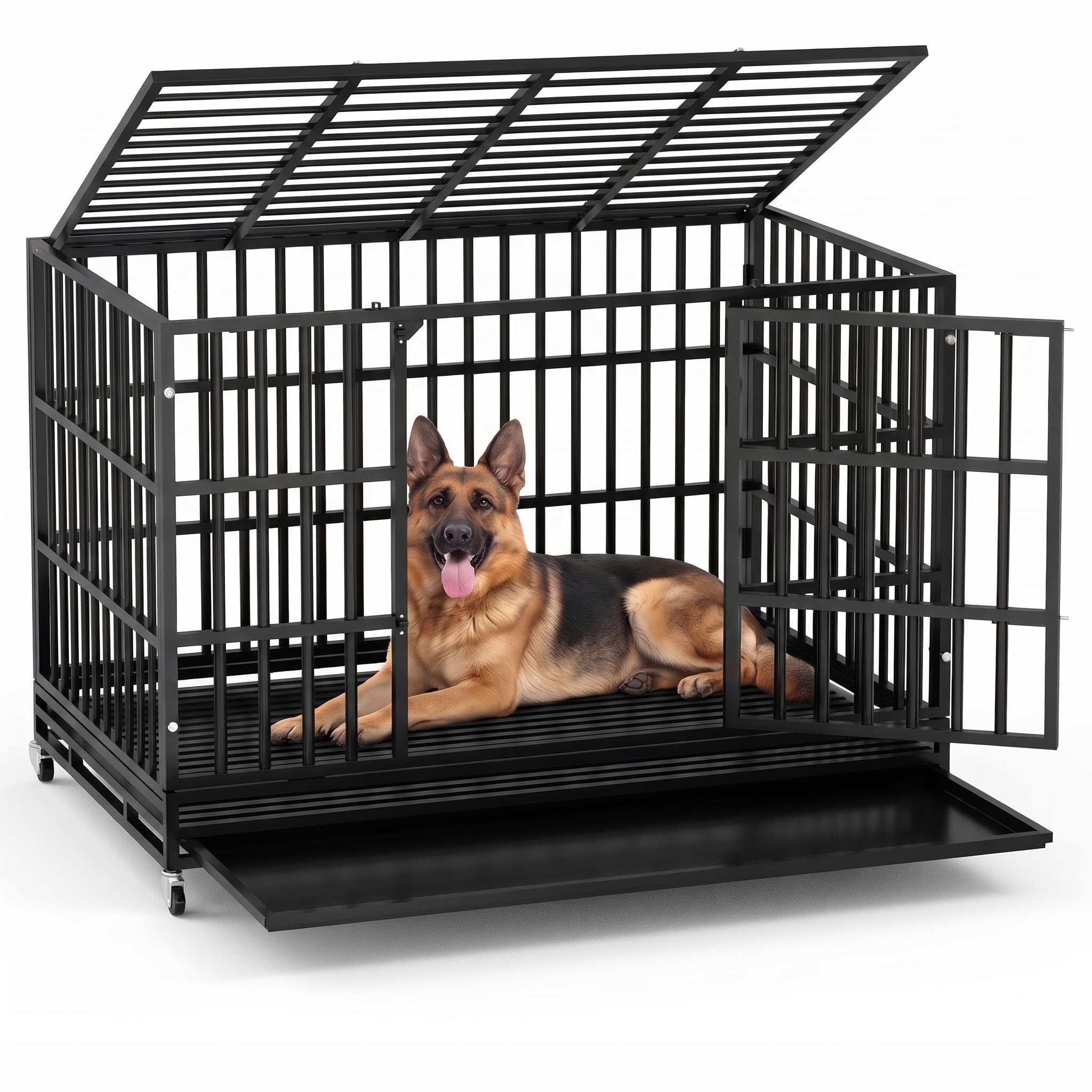
The LEMBERI 48-inch is another steel-frame option, with a wider overall footprint than the ProSelect Medium. The current listing gives external dimensions of 47.2 × 30.1 × 34.2 inches. It has a front entrance, an opening top, a removable tray below the floor grate and four swivel wheels, two of which lock.
The top opening can help with access while you remain beside the dog. It does not replace checking every latch or make leaving a worried dog alone safer. Its current seller description lists a weight of 81.8 pounds, so plan the route into the room before assembly and do not assume the wheels make stair transport easy.
The steel construction may be useful when an otherwise relaxed, crate-trained dog needs a more substantial enclosure. However, neither a large load-capacity claim nor a marketing description such as “escape-proof” proves resistance to a particular dog’s behavior. Full usable internal dimensions were not verified, so the 48-inch label should not be used as the dog’s sleeping length.
Fit reference: outside 47.2 × 30.1 × 34.2 in. Inside: Full usable internal dimensions not verified.
Pros
- Front and top openings provide different access points.
- Removable cleaning tray and two locking wheels.
Cons
- Heavy to lift: the current seller description lists 81.8 pounds.
- Grated floor and no verified complete internal measurements.
4. Impact Collapsible — 40-inch, Gray
Impact Collapsible — 40-inch, Gray
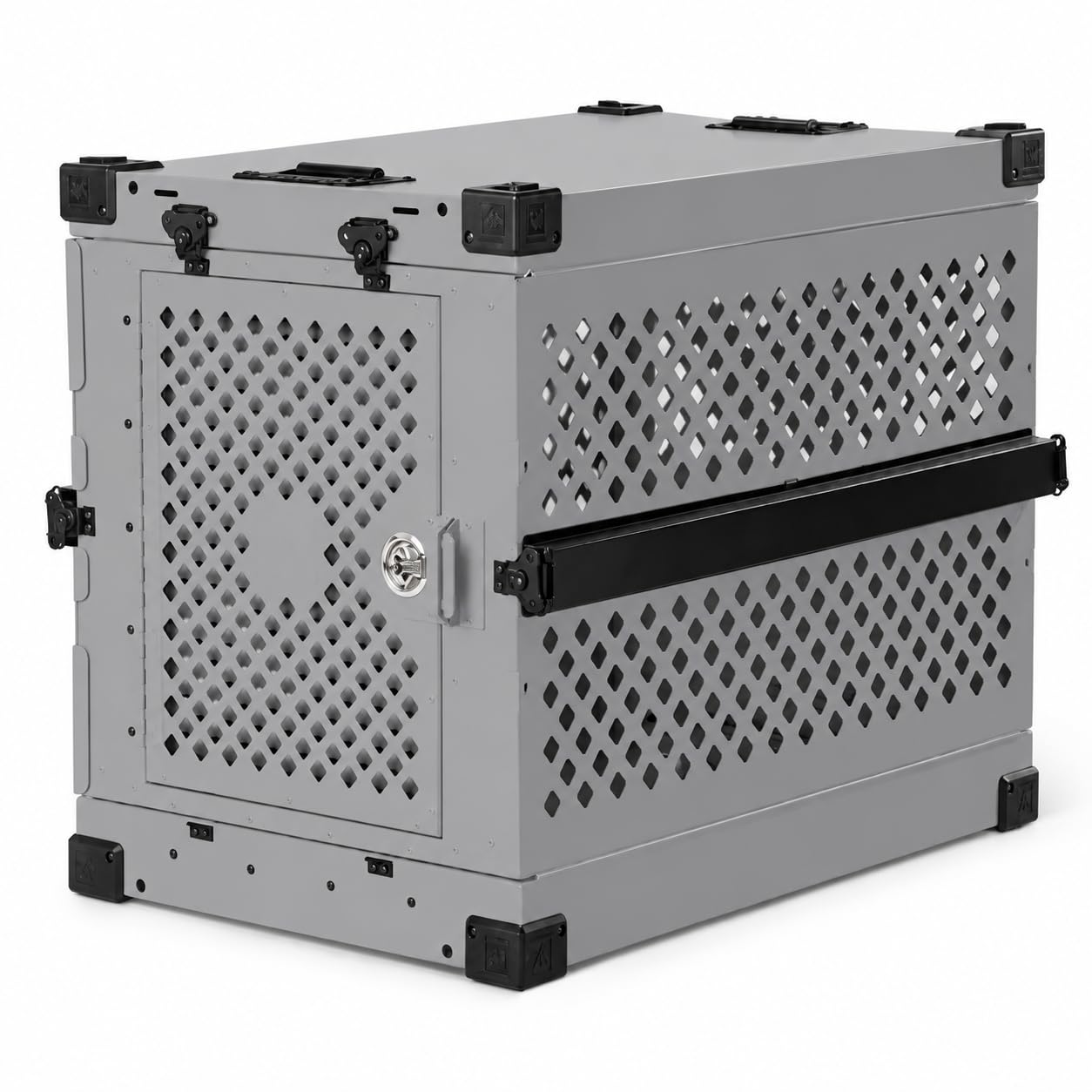
The Impact Collapsible suits a different job: a dog already comfortable in a crate whose owner wants an aluminum enclosure that folds for storage. The exact 40-inch Gray model measures 40.5 × 23 × 29 inches externally; Impact lists this size at 38 pounds. Its carrying handles and folding panels are practical when the empty crate needs to travel with you.
This is not the Impact High Anxiety model. Impact says the Collapsible is not recommended for dogs with a history of escaping, severe anxiety or destructive behavior. That distinction matters more than the shared brand name or the word heavy-duty.
Keep the folding design in perspective when comparing it with fixed steel or one-piece molded kennels. It can be a durable daily enclosure for an appropriate dog, but it is not a suitable upgrade simply because a dog has started forcing the door. The stated exterior size is not a verified usable interior measurement.
Fit reference: outside 40.5 × 23 × 29 in. Inside: Do not treat outside dimensions as usable interior.
Pros
- Folds down for storage; handles assist carrying the empty crate.
- Aluminum construction; the 40-inch size is listed at 38 pounds.
Cons
- Manufacturer does not recommend this model for escape history, severe anxiety or destructive behavior.
- External dimensions alone do not establish the usable sleeping area.
5. K9 Kennel Boss — Medium, Tan

K9 Kennel Boss — Medium, Tan
The Medium Tan K9 Kennel Boss is a folding aluminum crate with unusually clear sizing information. Its usable interior is 33.8 × 22.4 × 28 inches. With the side rails fitted, the exterior width is 25.2 inches; without that added width it is 23.2 inches. Including the rails when measuring a doorway avoids a frustrating fit mistake.
The manufacturer lists the medium at 36 pounds and the collapsed height at 8.6 inches with side rails. Sixteen supplied knurled bolts can increase rigidity. Those details make it worth comparing for a calm, crate-trained dog when storage space matters.
The seller explicitly cautions that collapsible crates may not suit dogs showing crate anxiety or destructive behavior. Folding convenience is the reason to consider this model, not an assumption that the extra bolts solve frantic escape attempts. It should not be used to continue an enclosure trial that is already upsetting the dog.
Fit reference: outside 34.6 × 25.2 × 28.9 in with side rails. Inside: 33.8 × 22.4 × 28 in.
Pros
- Published interior dimensions, weight and collapsed dimensions.
- Folding design with carrying handles and optional reinforcing bolts.
Cons
- Seller cautions against use for crate anxiety or destructive behavior.
- Side rails add two inches to the stated body width.
6. Dakota 283 G3 — Medium, Olive

Dakota 283 G3 — Medium, Olive
The Dakota 283 G3 Medium uses a one-piece rotomolded polyethylene shell instead of an exposed steel-bar enclosure. The Olive variant has a keyed paddle-latching door, a molded handle and 32 upper ventilation openings. A drain hole helps with cleaning, and the crate weighs 37 pounds.
Its external dimensions are 31 × 21.5 × 25.5 inches. Inside, Dakota specifies 28.5 × 19.8 × 25.2 inches at the tallest point, with a 14 × 20-inch door opening. The curved shell and doorway should both be considered: a dog may fit the floor plan but still find entering awkward.
The solid molded body and enclosed sides may appeal to an owner comparing alternatives to metal bars. They do not make polyethylene chew-proof, and the G3 does not fold for storage. Use it for a dog comfortable with the enclosure, and keep the ventilation openings unobstructed rather than covering the shell to force quiet.
Fit reference: outside 31 × 21.5 × 25.5 in. Inside: 28.5 × 19.8 × 25.2 in at tallest point.
Pros
- One-piece shell with a keyed latch and a drain hole.
- Documented interior dimensions and door opening.
Cons
- Rigid shell does not fold; doorway is 14 × 20 inches.
- Molded plastic should not be treated as impossible to chew.
7. Lucky Duck Lucky Kennel — Intermediate, Storm Grey

Lucky Duck Lucky Kennel — Intermediate, Storm Grey
The Intermediate Storm Grey Lucky Kennel is a rotomolded travel enclosure with a reversible door, a paddle latch, integrated tie-down points, lifting handles and non-slip feet. The pitched floor directs water toward drain channels, which is useful when comparing cleaning arrangements.
The exterior is 32.5 × 22.5 × 24.5 inches, while the interior is 30.25 × 20.5 × 22 inches. That 22-inch inside height is a clear limit for a dog that needs more standing or sitting room. Size names such as “Intermediate” are not interchangeable between manufacturers.
Consider it when a transport-oriented molded shell meets your dog’s measurements and your planned setup. Do not translate travel-related strength claims into a guarantee against chewing or panic. For vehicle use, the complete restraint arrangement matters; for routine home resting, confirm comfortable posture rather than choosing a tight fit just because it occupies less floor space.
Fit reference: outside 32.5 × 22.5 × 24.5 in. Inside: 30.25 × 20.5 × 22 in.
Pros
- Reversible door, tie-down points and non-slip feet.
- Molded floor with drainage channels.
- Inside and outside measurements are documented.
Cons
- Only 22 inches of usable internal height.
- Rigid molded shell needs permanent storage space and is not chew-proof.
What to look for when choosing a heavy-duty dog crate
Start with behavior, not the thickness of the bars
A calm dog pushing through a broken latch presents a different problem from a dog drooling, panting and repeatedly throwing themselves at a closed door. A more substantial crate can change the hardware. It does not remove the reason for the second dog’s distress. ASPCA and veterinary guidance warn that anxious dogs can injure themselves attempting to escape confinement.
Record what happens while you are nearby and what changes when you leave. Bring that information to your veterinarian if the behavior is persistent, intense or new. Do not set up a longer unsupervised trial to see whether stronger metal wins.
Compare usable space and the doorway
Your dog needs room to stand, turn and lie comfortably. Measure from the nose to the base of the tail, then record standing and sitting height. Compare those measurements with the actual usable interior, allowing room for natural posture and any bedding. Casters, trays, rails and curved walls can create a large difference between the outside label and the space available to the dog.
For example, the ProSelect Medium is 33¾ inches high outside but only 24½ inches high inside. The Dakota G3 Medium has a 14 × 20-inch doorway. Neither fact is obvious from the word medium. When a complete interior measurement is missing, do not substitute a guess based on the product name.
Inspect the floor, hinges and locks
Check how the door closes, whether each lock engages fully and whether fasteners remain tight after moving the crate. Grated floors need particular attention to paw placement, nails and resting comfort. A cleaning tray below a grate does not create a solid surface above it. For a dog that destroys bedding, adding a soft pad also introduces a separate chewing risk; our crate-pad comparison explains the construction choices.
Keep collars, tags, harnesses and leads out of the enclosure during crate rest to reduce snagging hazards. Do not repair a door with exposed wire or add restraints inside the crate. Stop using damaged equipment until the manufacturer has confirmed a suitable repair or replacement.
Separate home containment from transport
Wheels make it easier to move an empty crate around a room. They are not vehicle restraints. Aluminum construction, thick steel and a strong door are not, by themselves, evidence of crash performance. Use a vehicle-appropriate setup and the manufacturer’s restraint instructions. For flights, confirm the exact crate, dog and route with the airline; “heavy-duty” is not an airline approval.
At home, choose a stable, ventilated location away from direct heat and household traffic. Introduce the enclosure gradually with the door open and reward voluntary entry. Short, comfortable experiences give you better information than shutting the dog in for an hour as an initial test.
Compare the different types of heavy-duty crates
A fixed metal crate may make sense if the enclosure will stay in one room. Measure the route from the front door to that room before ordering, including any corners you’ll have to turn. If the crate comes with wheels, check how they lock and whether the crate sits steady where you’ll use it. Look at how far the door swings and whether you can reach the tray for cleaning without moving the whole crate.
A folding crate can save storage space between trips. Look at its folded size, how the panels lock into place and what the maker says about suitability for your dog. A molded kennel is a different shape, so check the actual doorway and interior where your dog stands and turns. These practical checks are easier to make with a tape measure than by comparing size names alone.
How to introduce your dog to a crate
Always introduce the crate slowly. Leave the door open and let your dog go in and out on their own. You can put a few treats near the entrance or offer part of a meal inside if they’re comfortable there. Once they can settle, try moving the door and opening it again. Build up in small steps while you’re nearby. If your dog shows distress, go back to a step they can handle comfortably.
Questions about heavy-duty dog crates
Is any dog crate truly indestructible?
No useful guarantee follows from that word alone. Look at the exact materials, door hardware, usable dimensions and documented limitations. A dog’s repeated attempts to bite or force an enclosure can cause injury even when the enclosure remains intact.
Should I buy a folding aluminum crate for an escape artist?
Not the two folding models in this comparison. Impact does not recommend its Collapsible for dogs with escape history or severe anxiety, and the K9 Kennel Boss listing cautions against anxiety and destructive behavior. Their folding convenience suits a different use case.
Will a stronger crate fix separation anxiety?
No. Equipment selection and treatment are separate decisions. A veterinarian can help assess the pattern and develop a plan, including an appropriate temporary arrangement. Persistent distress should not be handled by repeatedly extending confinement.
Can I choose a crate by breed or weight alone?
Use those only as a starting point. Body length, sitting height, turning room, doorway access and the intended use determine the practical fit. Two dogs of similar weight can need different interior proportions.