The-Hunting-Dog is supported by its audience. We may receive commissions on purchases made from links on our site.
Want a recall signal that’s easy to repeat? A dog whistle gives you a consistent cue to build into training. Compare these three designs to find the sound and style that suit you.

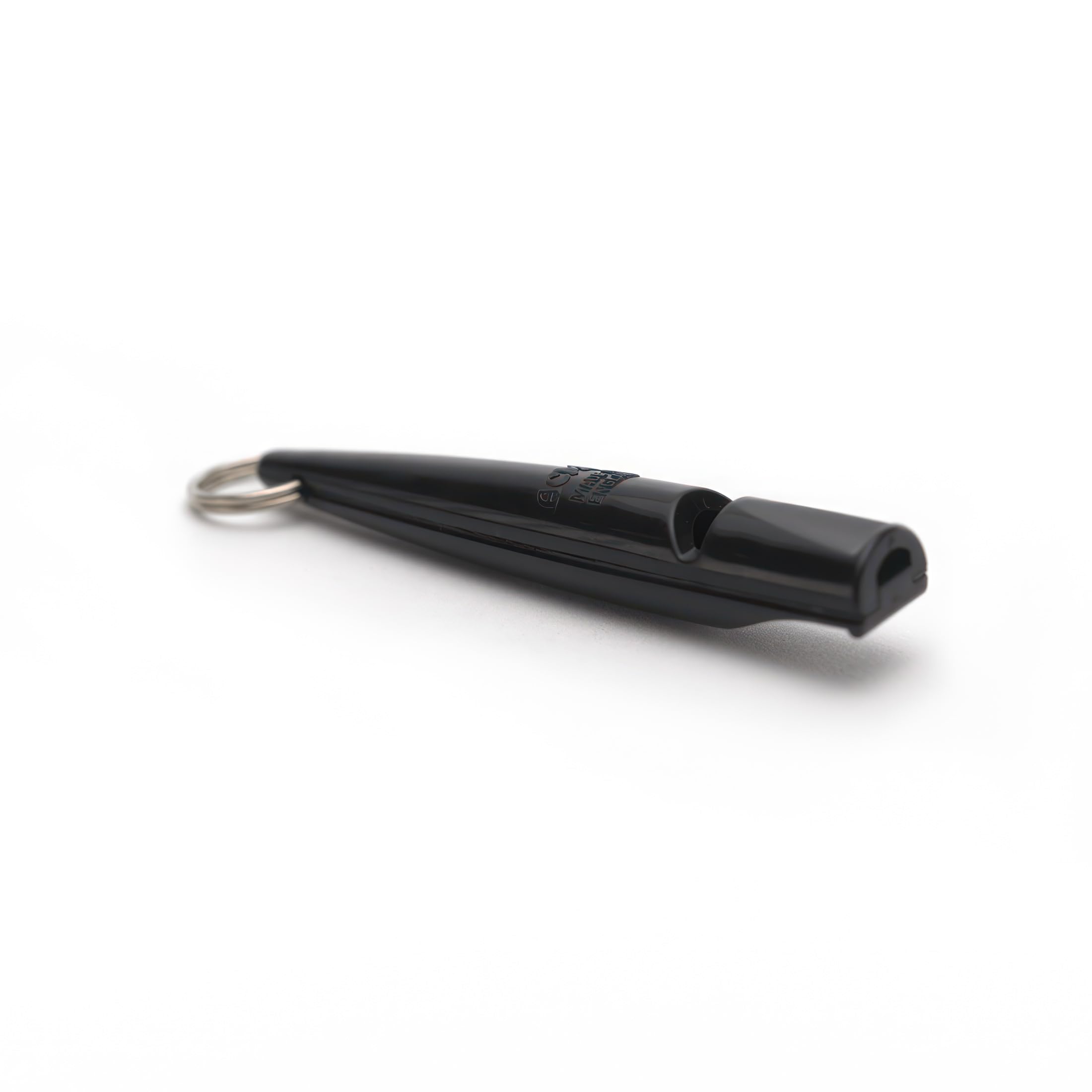
ACME 210 — Black
A dog whistle is a signal you teach, not an automatic way to stop barking. A useful choice gives you a cue you can repeat comfortably and consistently. This guide compares three distinct designs: a fixed-note pealess whistle, a pea whistle with a trill, and an adjustable model.
Choose the signal before the accessories
For a plain sequence of pips, compare fixed-note pealess whistles. For a rolling sound, a pea whistle is a different option. An adjustable model offers another variable, but the setting needs to stay consistent while your dog learns.
Audible and “silent” whistles both require training. Do not assume a high pitch is suitable for every dog or that a louder blast is a better cue. Introduce sound gently at a comfortable distance, never directly into an ear. A dog that seems distressed needs a calmer setup; sudden changes in hearing or behavior call for veterinary advice.
Before working at a distance, teach the whistle to predict rewards. Our step-by-step whistle recall guide explains how to start close, add a familiar recall, and increase difficulty in a secure place.
1. ACME 211.5 — Purple

A straightforward choice for a repeatable recall cue. The ACME 211.5 is a fixed-pitch, pealess whistle that produces a single note. This purple plastic version is easy to distinguish from the other designs in the comparison. ACME lists a nominal frequency of 4,850 Hz for the model.
Use the number and length of pips to create a recognizable signal. A fixed note gives you one less setting to manage during training, and a spare in the same model can help you keep that cue consistent. The 211.5 is commonly associated with retriever training, but the essential step for any dog is learning what your chosen signal means.
Choose this model if you want a plain, consistent note. If you prefer a rolling trill, the ACME 210 below has a different sound; for adjustable pitch, consider the 535.
- Pealess, single-note design supports a consistent cue
- Named model and pitch make it easier to identify a matching spare
- No pitch adjustment; choose another design if you need a tunable whistle
2. ACME 210 — Black
A distinct rolling sound for handlers who prefer a trill. The ACME 210 uses a cork pea to produce its characteristic trilling note. ACME describes the pea as weatherproof and the high-pitched whistle as suited to close work.
Its sound gives you a different option from the pealess 211.5. Decide which signal you can produce comfortably and consistently, then pair it with rewards before expecting a response at a distance. Keep the same recall pattern as you move between short sessions at home and practice in a secure outdoor area.
Pay attention to the model number when choosing a spare: the 210 and the pealess 210.5 are different designs. The black 210 pictured here suits someone specifically looking for a pea whistle.
- Pea produces a distinct trilling signal
- High-pitched trilling sound for close work
- Trilling sound differs from a pealess single note; it is not a like-for-like spare for a 211.5
3. ACME 535 Silent Dog Whistle

An adjustable option for handlers who want to choose the pitch. The ACME 535 has a brass body and a screw-piston mechanism for changing its sound. Its instruction booklet explains adjustment and training.
Set the whistle before you begin teaching the cue, then keep that setting consistent. Introduce a gentle signal and reward your dog for responding. The aim is a sound your dog has learned to recognize, rather than the strongest reaction you can get by changing the pitch or blowing harder.
The 535 can be faintly audible to people despite its “silent” name. It is worth considering if adjustment matters to you; a fixed-note model is simpler if you would rather avoid managing a pitch setting.
- Pitch can be adjusted with a screw-piston mechanism
- Brass body with an adjustment and training booklet
- Requires setting and consistent use; not the simplest fixed-note replacement
- Faint human audibility means it is not completely silent
What a whistle can and cannot do

A whistle can provide a consistent cue; it does not tell a dog what that cue means. It cannot guarantee a return around wildlife, make an unfamiliar dog obey, or resolve the reason a dog is barking. Repeatedly blowing it to startle a dog is not the reward-based recall training described here.
Practice in an enclosed space. Outdoors, retain a leash or suitable long line where an unsuccessful recall would be dangerous. A long line belongs on a well-fitting harness and requires enough clear space to avoid tangles. A whistle does not replace physical control or local leash rules.
Build a recall you can maintain
Choose one pattern and ask every handler to use it. Reward the return, including a slow one. Gradually change distance, location and distraction rather than increasing all three together. If the dog struggles, reduce the difficulty; repeating the signal more loudly is not a substitute for teaching it.
Keep a separate verbal recall and a plan for a lost whistle. Once your chosen signal is learned, a spare of the same model is more useful than an unrelated whistle chosen only for its color.